Open Sourcing the Future: Why China's ERNIE 5.0 Could Make AI Free (and Unstoppable)—Even as Big Tech Keeps Its Crown Jewels Locked Away

There's a war underway—and it's not being fought with chip embargoes or tariffs.
It's happening in the open-source repositories, the model weights flying across GitHub, and the benchmarks that get leaked before press embargoes lift. On one side: Silicon Valley's closed vaults, where GPT and Gemini live behind API walls and billion-dollar moats. On the other: China's ERNIE 5.0, Baidu's newest multimodal powerhouse—released fully open-source and already claiming to beat Western rivals in visual understanding, reasoning, and real-world deployment.
The question isn't "who's winning?" anymore.
It's "what happens when half the world gets access to frontier AI for free?"
Welcome to the new AI arms race, where openness is the weapon—and the strategy is to move so fast that the competition can't keep up.
ERNIE 5.0: China's Multimodal Monster Goes Public
Baidu didn't just launch ERNIE 5.0 earlier this month—it opened the floodgates. This isn't a limited API or a watermarked trial. It's a full release: model weights, training methodologies, benchmark results, and integration paths for developers worldwide. ERNIE 5.0 is natively multimodal, meaning it seamlessly handles text, images, audio, and video in a single pass—no stitching, no separate pipelines.
The results? Eye-opening. In Baidu's internal tests, ERNIE claimed superior performance to GPT-5 and Gemini 2.5 Pro in visual understanding tasks—especially complex scene analysis and "thinking with images," where the model zooms, scans, and reasons about visual data like a human would. And it's not just benchmark bragging: during China's massive "Double 11" shopping festival, 83% of livestream hosts used Baidu's AI-powered digital humans and agentic tools, driving record engagement and sales.
If you're in marketing, content, or e-commerce, this should make you sit up. ERNIE isn't theoretical. It's already powering campaigns, commerce, and creative at a scale most Western brands haven't touched.
But Let's Be Real: ERNIE 5.0 Isn't Perfect—And It's Not Alone
Before we crown ERNIE the king of open-source AI, let's pump the brakes. Real-world testing reveals some significant gaps:
Limitations users are reporting:
- No live web search: Unlike some competitors, ERNIE can't pull real-time data from the live web, limiting its use for current events or dynamic research.
- Video generation is missing: Despite multimodal claims, ERNIE doesn't create videos—a capability rivals like Hunyuan and MiniMax are already shipping.
- Image generation is... okay: Independent testers note ERNIE's image output is "acceptable" but falls short of specialized models, especially for faces and photorealistic styles.
- Instruction-following issues: Early adopters report ERNIE struggles to follow explicit instructions, sometimes ignoring user commands and forcing tool usage even when told not to.
- Creative writing gets muddled: The model blends facts and logic inconsistently in longer creative tasks, requiring heavy human editing.
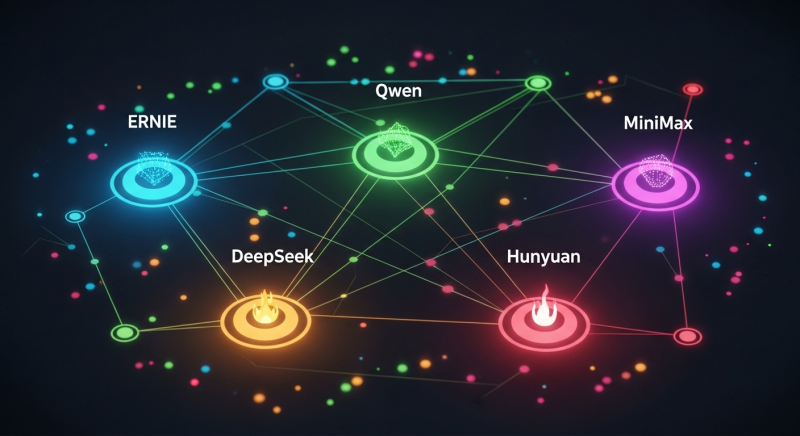
And ERNIE isn't the only player in China's open-source arena:
- DeepSeek V3 outperforms ERNIE on advanced math benchmarks and is favored by many developers for specialized reasoning tasks.
- Qwen 2.5 Max (Alibaba) is a direct competitor with strong performance across Chinese-language tasks and growing international adoption.
- Hunyuan (Tencent) just released massive open-source models with 389 billion parameters, plus cutting-edge 3D world generation and on-device AI—capabilities ERNIE doesn't touch.
- MiniMax and others round out a field of 1,500+ Chinese AI models now competing for developer mindshare.
In fact, when Baidu announced ERNIE 5.0's benchmark wins, investors weren't impressed—shares dropped 9.8% the next day. Why? Because technical excellence alone doesn't guarantee market dominance in China's hyper-competitive AI landscape.
So why is ERNIE 5.0 getting all the headlines this week?
Timing, scale, and Baidu's marketing muscle. ERNIE's fully open-source release hit at a moment when Western AI anxiety is peaking, and Baidu's ecosystem (search, cloud, commerce) gives it distribution other labs can't match. But make no mistake: ERNIE is one move in a much larger game—and DeepSeek, Qwen, and Hunyuan are all playing to win.
The Great Divide: Open Source vs. Closed Source—And Why It Matters
Here's where philosophy meets power.
Western AI: Closed, Controlled, Commercial
OpenAI, Google DeepMind, and Anthropic have largely embraced a closed-source strategy. Their models are accessed via API, with strict usage terms, rate limits, and proprietary training data that will never see daylight. The rationale? Safety, alignment, competitive moats, and—let's be honest—massive revenue streams. If you want GPT-5 or Gemini, you rent it. You don't own it.
This approach has upsides: rigorous safety testing, centralized accountability, and polished user experiences. But it also creates bottlenecks, vendor lock-in, and limits on what developers can build. Want to fine-tune GPT-5 on your proprietary dataset? Good luck. Want to run it locally without sending data to the cloud? Not happening.
Chinese AI: Open, Fast, Pragmatic
China's leading AI labs—Baidu, Alibaba, ByteDance—are racing in the opposite direction. ERNIE 5.0 joins a wave of open-source releases designed to flood the market with accessible, customizable, and locally deployable models. The philosophy? Speed beats perfection. Adoption beats control. And if you give the world free tools, they'll build your ecosystem for you.
ERNIE 5.0 is fully open source: anyone can download it, modify it, and deploy it without paying Baidu a cent (beyond infrastructure costs). This enables rapid innovation in verticals that Western AI companies haven't prioritized—hyperlocal e-commerce, region-specific content generation, and integration with China's massive social and livestream platforms.
Where Does ERNIE 5.0 Fit? The Open Camp—With a Twist
ERNIE 5.0 sits firmly in the open-source camp, but with strategic nuance. Baidu isn't doing this out of altruism. By open-sourcing ERNIE, Baidu:
- Accelerates adoption across China's vast developer ecosystem.
- Builds goodwill and mindshare in international markets frustrated by Western API costs.
- Speeds up feedback loops—thousands of developers stress-test, fine-tune, and report issues faster than any internal QA team could.
- Positions itself as the foundation layer for AI-powered apps, even if Baidu doesn't capture direct revenue from every use case.
In short: Open source is Baidu's go-to-market strategy—not a compromise, but a competitive weapon.
What This Means for Marketers, Founders, and Strategists
If you're building campaigns, brands, or businesses, the ERNIE 5.0 release is a signal flare:
The cost of "frontier AI" is collapsing.
What took OpenAI $100M+ in compute to build, you can now run locally (with the right hardware) or customize on cloud instances at a fraction of the cost. For lean teams and emerging markets, this is a game-changer.
Customization beats one-size-fits-all.
Closed models force you into their worldview, their guardrails, their content policies. Open models let you fine-tune for your audience, your language, your brand voice—without waiting for Big Tech's roadmap to catch up.
Speed wins.
Western companies obsess over alignment and safety (important, but slow). Chinese labs ship fast, iterate publicly, and let the market decide what works. If you're competing globally, you need to ask: are you building at China speed, or Silicon Valley speed?
The "AI divide" is widening.
As more powerful models go open source, the gap between "AI haves" (those who can deploy, customize, and scale) and "AI have-nots" (those stuck renting APIs) will grow. The smart move? Start experimenting with open models now, before your competitors do.
The Risks (Because There Always Are)
Open source isn't a utopia. ERNIE 5.0's rapid release raises questions:
- Safety and alignment: Who's responsible when an open model generates harmful content or enables bad actors?
- Intellectual property: If thousands of developers fork and modify ERNIE, who owns the resulting innovations?
- Geopolitical tension: Western governments are already nervous about Chinese AI dominance. Open-source models crossing borders could accelerate regulatory crackdowns.
But here's the thing: these risks exist whether or not ERNIE goes open. The genie's out of the bottle. The question is whether your business is ready to use it—or get left behind by those who are.
Action Steps: What to Do Next
- Test ERNIE 5.0 in a sandbox. Download the model, run it on a non-critical project, and compare results to your current AI stack.
- Audit your AI strategy. Are you locked into expensive APIs that could be replaced by open alternatives?
- Watch the benchmark wars. ERNIE's claims are bold—third-party validation will tell the real story. Follow independent tests closely.
- Build optionality. Don't bet your entire AI stack on one vendor. Multimodal, open-source models give you negotiating power and fallback options.
The Bottom Line:
China just opened the vault. The West is still deciding whether to unlock the door. And while the debate rages, the rest of the world is downloading ERNIE, building apps, and moving forward.
The future of AI might not be closed. It might not even be American. It might just be open—and Chinese—and fragmented across dozens of fierce competitors, each pushing different strengths. ERNIE 5.0 is this week's headline, but next week it could be DeepSeek's reasoning breakthrough or Hunyuan's 3D world models. The real story? The open-source flood has started, and no single model will dominate.
Stay tuned: next week, we're diving deep into the full open vs. closed AI model war—and what it means for your business.
Bangkok8 AI: We'll show you where the world is heading—and how to get there first.